Monday, November 18, 2013
Oven Roasted Vegetable Ratatouille
Ratatouille is one of the great Mediterranean dishes, perfuming the kitchen with the essence of Provençal cuisine and all the glorious colours of autumn. Made with diced eggplant, zucchini, peppers, and tomatoes, this delicious Ratatouille is prepared by oven roasting the vegetables on a parchment lined baking sheet, which allows them to retain their own shape, texture and character. Once the vegetables have been roasted in the oven for about an hour with some lovely fresh herbs, garlic and a little olive oil, they're combined in a large bowl or serving platter, allowing the flavours to finally come together in one big happy marriage. As with any ratatouille, it tastes even better the next day, so it's an ideal make-ahead dish.
Oven Roasted Vegetable Ratatouille
Serves 8
1 medium eggplant, cut into cubes - about 4 cups
2 medium zucchini, cut into 3/4-inch dice
2 bell peppers, red and yellow, de-seeded and diced
2 cups cherry tomatoes, halved
4 cloves garlic, minced
2 sprigs rosemary
2 sprigs thyme
2 tbsp olive oil, divided
1/2 tsp salt
1/4 tsp ground black pepper
Position racks in the top and bottom thirds of the oven and heat the oven to 400°F. Line two large rimmed baking sheets with parchment. In a large bowl, toss the eggplant, peppers, tomatoes, zucchini, garlic, olive oil, rosemary, salt and pepper. Spread the vegetables evenly over both sheets.
Roast, stirring the vegetables a few times, until the vegetables are slightly collapsed or shriveled, starting to brown, and very tender, about 60-80 minutes. If the vegetables look like they may burn, turn down the heat or pile them closer together. If they look dry, drizzle on a little more olive oil. Using a slotted spatula, spoon all of the vegetables and any juices into a serving bowl. Serve warm or at room temperature.
Friday, November 15, 2013
Poached Seafood Salad with Lemon Dill Sauce
A lovely light salad to make anytime of the year, is a plump and juicy Poached Seafood Salad made with large shrimp, scallops, squid and a few tiny salad shrimp for good luck. The large shrimp are shelled and deveined; the squid are cut into rings; and the scallops are cut in half. They are all then poached for a few minutes in a shallow pan of simmering water until just done, then left to cool about 10 minutes. The mixed seafood is then tossed in a light lemon dill sauce and served with a wedge of fresh lemon. I served this seafood salad over a small bed of homemade celeriac remoulade for a light crunchy surprise at the bottom. Wonderfully light and delicate, this beautiful seafood salad makes an elegant appetizer or delicious entrée, with some extra lemon dill sauce on the side for good measure.
Poached Seafood Salad with Lemon Dill Sauce
Serves 2 as an entrée or 4 as an appetizer
10 large shrimp, shelled and deveined
4 large scallops
2 cleaned squid with tentacles
1 cup small salad shrimp
2 tbsp capers
1 lemon, for garnish
Lemon Dill Sauce:
1 cup sour cream
1 lemon, juiced
2 tbsp fresh dill, chopped
1 tsp salt
Celeriac Remoulade:
1 celeriac root
1 tsp lemon juice
2 tbsp mayonnaise
1 tsp caraway seeds
Maldon salt and white pepper to taste
For the lemon dill sauce, whisk all ingredients together in a small bowl, then cover and refrigerate until needed.
Slice the squid into 1/4-inch thick rings and cut the tentacles in half. Slice the scallops in half. Set a medium pan of water over med-high heat and once a few bubbles start to appear, lightly poach the shrimp, scallops and squid, one type at a time then set in a colander once done. Let cool for a few minutes then toss with 1/2 cup of lemon dill sauce and some capers.
For the celeriac remoulade, start by paring away the outer skin of the celeriac root using a vegetable peeler, then slice it into thin matchsticks using a mandolin or a sharp knife. Toss the 'matchsticks' in a small bowl with a squeeze of lemon juice to preserve the colour and to prevent it from going brown. Then add some mayonnaise and toss to combine. Season with caraway seeds and some Maldon salt and white pepper to taste.
To serve, spoon some of the celeriac remoulade in the bottom of each serving bowl and top with some of the mixed seafood salad with a wedge of lemon for garnish.
Thursday, November 14, 2013
Poached Eggs on Wild Baby Arugula
Starting the day with a healthy breakfast that includes eggs provides a nutritious start to any morning, and a low-cal one too when poached and served over a bed of tender peppery arugula. Like most salad greens, arugula is packed with important nutrients such as vitamin A, calcium and iron, with a calorie content that is incredibly low at just five calories per cup. With very few calories and tons of flavour, it's a great green to help maintain a healthy weight without sacrificing great tasting foods!
Poached Eggs on Wild Baby Arugula
Serves 1
1 1/2 cups wild baby arugula
2 large eggs
1/4 cup white distilled vinegar
Maldon salt, fresh ground black pepper and paprika, to taste
Loosely arrange the arugula on a plate or dinner bowl and set aside. Pour the vinegar into 2 small bowls, and crack one egg into each bowl, being very careful not to break the yolk. Let stand for five minutes.
Meanwhile, bring a medium saucepan of water to a boil over medium-high heat. Using a whisk, vigorously swirl the water until a vortex forms in the centre. Slip the eggs with the vinegar into vortex, one at a time, and continue to swirl the water with the whisk around edges of pan until it returns to a boil. The egg white should wrap tightly around the yolk, forming an oval shape.
As soon as the water returns to a boil, reduce the heat to medium and gently simmer the eggs, frequently swirling the water, for 2 minutes. Using a slotted spoon, lift the eggs from water, place them onto paper towel and gently blot. To serve, place the poached eggs on top of the arugula and season with freshly ground pepper, Maldon salt and a sprinkle of paprika.
Wednesday, November 13, 2013
Bindia: Sensational Indian Cuisine on Market Street
Bindia's modern and sophisticated logo
Bindia's snazzy modern interior with contemporary wood finishes, warm golden hued pendant lighting, comfortable seating and dramatic blue and white murals featuring indian-inspired design motifs, provide a fun and sophisticated backdrop for the restaurant's warm hospitality and excellent cuisine. A relative newcomer to the hood, owner Michael and his wife Jyoti say they are thrilled to be a part of the historic St. Lawrence neighbourhood and are moved by the enthusiastic support and encouragement they've received so far from area residents. The restaurant was positively buzzing when we arrived for dinner on a chilly Saturday night.
Michael, the wonderfully friendly and charming owner of Bindia, together with his beautiful
and gracious wife Jyoti and brother-chef Chandan
A consistent fresh blue and white colour palette is echoed throughout the restaurant,
from interior finishes to smart table setting details
The menu
The menu features a full selection of appetizers, tandoor dishes as well as Indian classics including vegetarian selections, rice, naan, chapati, condiments and desserts
As we perused Bindia's extensive menu, fresh pappadam and fragrant coriander mint chutney arrived to whet our appetite and provided a glimpse of the excellent food to come. As we considered which wine to choose from the carte des vins, our server suggested the 2012 Reméage Rosé de Syrah, a rich and satisfying rosé which, as we would discover, paired beautifully with the food.
Bindia complimentary pappadam and coriander mint chutney
The 2012 Reméage Rosé de Syrah paired beautifully with the food
Rich in colour and full of flavour, the rosé was delicious
With a tempting selection of eight appetizers to select from, we decided to start with Bindia's Vegetable Samosas filled with potatoes, peas and spices, and the Vegetable Pakoras, mixed vegetable fritters in a gram flour batter. An ardent and unwavering fan of Indian cuisine, I've had the pleasure of dining in many fine Indian restaurants around the world, but Bindia's samosas and pakoras were among the best I've ever had. Ethereally light and flaky, the samosas were mouthwateringly delicious, and the vibrant saffron-hued pakoras were delicately fried and full of flavour. When our server came to remove the plates, she asked how we enjoyed the appetizers. After we gave her an enthusiastic 'thumbs up', I had three words for her — "Who's the chef!"
Ethereally light and flaky Vegetarian Samosas served with a flavourful tamarind chutney
Mixed Vegetable Pakora fritters in a gram flour batter served with tamarind chutney
Trying to decide on two or three entrées was a challenge, as everything on the menu sounded amazing. An array of dishes 'from the tandoor' included Chicken Tikka, Tandoori Jumbo Prawns, Lamb Seekh Kabab, Tandoori Lobster Tail, Tandoori Lamb Chops and the family-style Tandoori Platter with a selection of Chicken Tikka, Jumbo Prawns, Paneer Tikka and Chicken Kabab, to traditional Indian classics such as Butter Chicken, Lamb Vindaloo, Dal Makhni, Palak Paneer, Baingain Bharta and Biryani. The menu also features Basmati and Pilau Rice, as well as Garlic, Stuffed, Regular Naan and wholewheat Chapati.
Butter Chicken: tender pieces of tandoori grilled white meat
simmered in a rich creamy tomato sauce with special house blends
House made yogurt Raita with shredded cucumbers and roasted cumin
Dal Makhni: slow cooked black lentlls in a rich cream sauce with ginger,
garlic, tomato and fresh coriander
Homemade pickle
Palak Paneer: fresh spinach purée cooked with Indian cheese, garlic, ginger
and tomatoes with a touch of cream
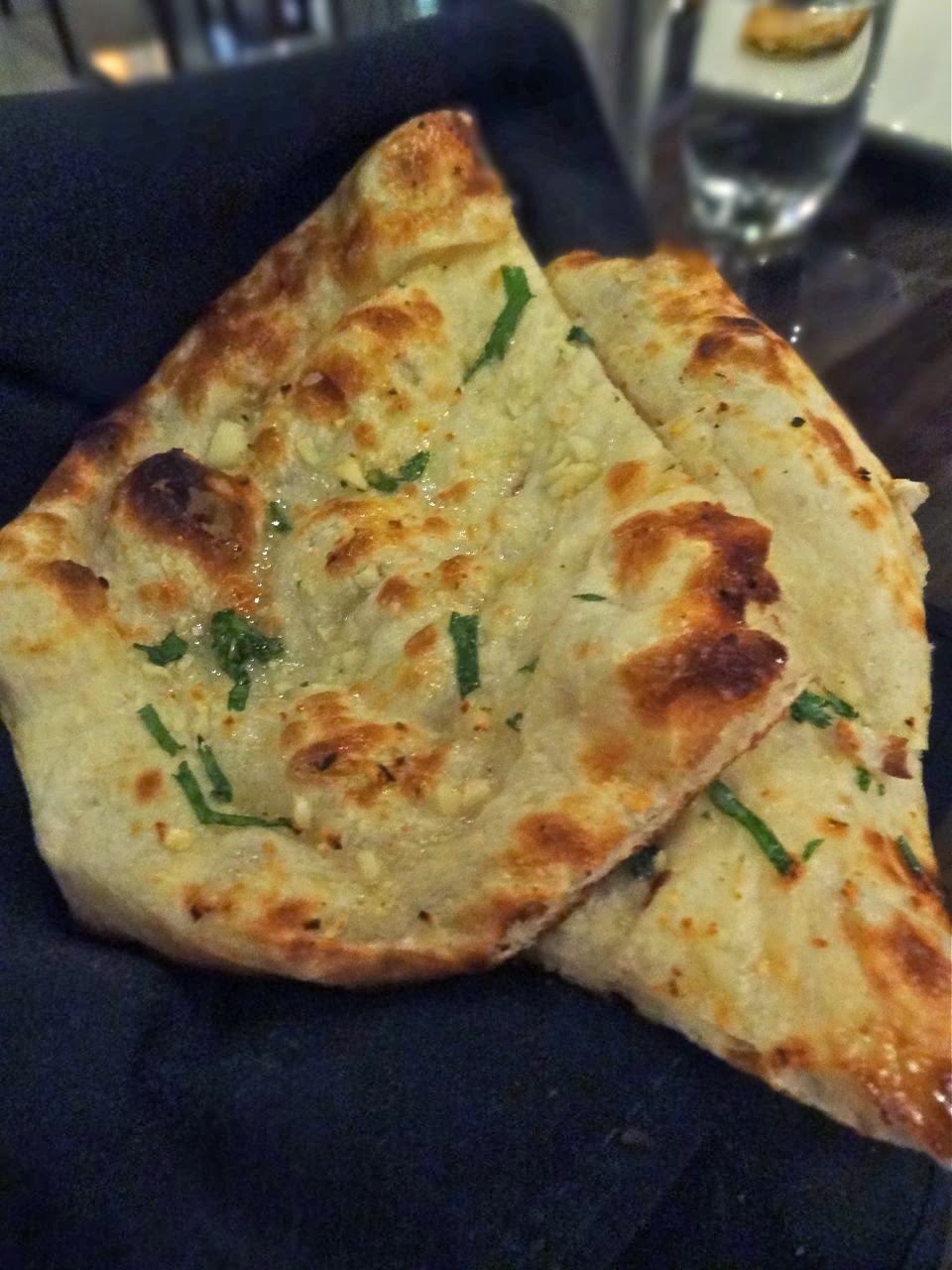
Garlic Naan
Bindia Stuffed Naan with tandoori chicken, onions, green peppers and mild spices
To our great surprise, Chef Chandan took time out from his busy kitchen to bring our spectacular platter of Tandoori Jumbo Prawns and to introduce himself. Word had obviously travelled quickly that he had a swooning admirer. Not only is Chef Chandan a tremendous cook, he is also a lovely, warm and gracious man with an enormous heart. He echoed his brother-in-laws delight in being in the St Lawrence neighbourhood, but also being so close to the market where he buys most of his ingredients. A man after my own heart. Having lived in the area myself for almost 30 years, the market is my culinary beacon also.
Chef Chandan took time to bring out our prawns and chat with us about the restaurant.
A thoroughly charming fellow, he was as lovely as his cuisine.
Tandoori Jumbo Prawns marinated with tandoori spices
Plump, moist and absolutely delicious, the presentation made the dish even more dramatic
Tandoori lamb Chops marinated with fresh herbs and yogurt serve with
vegetables and fresh mint chutney
Kulfi, an Indian ice cream flavoured with cardamom and garnished with shredded coconut
Tuesday, November 12, 2013
Takht-e Tavoos: Fabulous Persian Cuisine on College
Takht-e Tavoos is the latest venture from Alireza Fakhrashrafi and Danielle Schrage, the husband and wife team responsible for The Pomegranate and Sheherzade Dizi & Grill at College and Bathurst. Fakhrashrafi first settled in Montreal then moved to Ontario to study environmental sciences at U of T. While he always hoped that he would be able to return to Iran one day, he met Danielle Schrage in 1992 and fell in love. They married a year later. The father of two worked as an immigration consultant and published a monthly magazine, but his friends encouraged the talented cook to open a restaurant. So, in 2002, Fakhrashrafi and Schrage opened The Pomegranate, concentrating on Persian home-style cooking. "In Iran, most restaurants focus on kebabs. Home-style food is a totally different universe. You never see it on the streets."
Alireza Fakhrashrafi and Danielle Schrage photo: Shlomi Amiga
In 2008, the couple opened a sister restaurant next-door called Sheherzade, which specializes in grilled foods and clay pot cooking. He tore down the wall between the kitchens, easing the grind of a two-restaurant chef. "I do two hours of work here, then two hours of work there. It’s fun for me." The third venture is Takht-e Tavoos on College Street, open from 10:00am to 4:00pm only, and serves sumptuous brunch and lunch specialties, from various regions of Iran. And Ali still does all the prep! A dinner menu is in the works.
Local Toronto painter Roxanne Ignatius created the cedar-tree border
along the wall in the front room
The interior of Takht-e Tavoos
A flotilla of teapots grace the bar at Tavoos
For the pure Persian experience, we sat at the semi-private "takht",
a carpeted seating platform with padded backrest and plump pillows
The vibrant Persian cuisine at Takht-e Tavoos includes specialties like Kalleh Pacheh, a soup made from sheep’s head and hooves, and Haleem, porridge made from wheat berries with shredded lamb. At breakfast, there’s a range of egg-based dishes like Guisavah served with Persian flat bread and a cup of Persian tea or fresh coffee, and for lunch, there are various meze appetizers and Dizi Sangi, a stone pot stew. Fragrant bergamot-scented Persian tea is brewed in a samovar as well as Turkish coffee, which is boiled in a traditional ibrik pot with sugar and cardamom.
Even water is treated with a sense of occasion, arriving on a small silver tray
Takht-e Tavoos brunch & lunch menu
We began our lunch with two glasses of aromatic Persian tea, which arrived in style on a silver tray with a bowl of sugar cubes. "Every home has their own style," says Schrage. "You serve it in a glass, and drink it with the sugar in your mouth, with no milk." Not having much of a sweet tooth, I forgot the sugar and enjoyed the tea on it's own. The intoxicating fragrance of fresh cardamom was extraordinarily refreshing and flavourful. Our server informed us that the tea is purchased as a concentrate then brewed to taste, with the addition of fresh cardamom added for maximum impact. It was excellent.
Persian samovar-brewed black Chai tea with cardamom, served in a glass
and meant to be enjoyed with a sugar cube in your mouth
As an appetizer or meze, we decided on Mushroom Parvardeh, a purée of mushrooms, walnuts and garlic garnished with fresh mint, pomegranate molasses and zereshk, also known as Persian barberries. Served with warm Persian flatbread, and quite addictive in it's own right, the dip was like a nutty pesto but with delicate sweet and sour quality due to the pomegranate and tangy barberries.
Mushroom Parvardeh, a purée of mushrooms, walnuts and garlic garnished with fresh mint, pomegranate molasses and zereshk (Persian barberries)
Persian flatbread, warm and addictive, is served with the Parvardeh
Tavoos’s specialty dishes are the standouts. For entrees, we ordered the Dizi Sanghi and Kaleh Pacheh. Dizi is one of the most popular dishes in Iran, is served in that tall stone pot, is the most complex and visually appealing of Tavoos’s heavier dishes. The stew is a two-part meal, with the broth decanted into a soup bowl, and the lamb and vegetables in the dizi pot. It all comes on a silver platter, with a long, metal pestle that’s used to mash the stew. The stew, once it’s mashed, is spooned onto the flatbread, with yogurt and pickled vegetables. The soup is sopped up with little bits of flatbread. The broth is meaty, thick with starch from chickpeas and white beans, with accents of bright-flavoured lime and turmeric and is absolutely delicious.
Dizi Sanghi, a stew that is a two part meal with the broth decanted into a soup bowl,
and the lamb and vegetables in the dizi pot
Yoghurt garnished with rose petals and mint
A sheep soup, called Kaleh Pacheh, is perhaps the simplest and most authentic of them all. Kaleh Pacheh is breakfast food around Iran, lightly seasoned and often served in small specialist restaurants that open at dawn and close before 8:00am. It's commonly, but not always, served with whole sheep’s heads, with an option of ordering extra parts such as cheek, brain or eyes. There's some debate among Iranians as to whether it's best served with or without the eyeballs. At Tavoos, the soup is made with the tongues, a bit of mashed brain, cheeks and sheep’s hooves only. Chef Ali says he hopes to be able to offer a menu of extra parts in future. Count me out!
Kalleh Pacheh, a true Persian delicacy made from sheep’s head, hooves, mashed brain and tongue served in a broth with Persian flatbread and pickled garlic
For dessert we couldn't resist the Sholehzard, a chilled Persian saffron rice pudding topped with pistachios, almonds and cinnamon. Wonderfully vibrant with splashes of nutty aromatic accents, the pudding was the perfect end to a wonderful meal. Another pot of Persian chai tea, and we were on our way, with plans to return but also try Pomegranate and Sheherzade, and explore more of the phenomenal flavours of Ali and Danielle's modern persian cuisine.
Sholehzard, a chilled Persian saffron rice pudding topped with pistachios, almonds and cinnamon
The Persian tea is wonderfully fragrant and full of fabulous flavour
with cardamom hand ground and added to each pot brewed
Tavoos A-Frame
Mirza Qasimi - Warm Persian Eggplant Garlic Dip
Serves 4
Recipe courtesy Chef Alireza Fakhrashrafi, Takht-e Tavoos
2 large eggplants, about 1 lb each
1/4 cup olive oil
1/4 cup finely chopped garlic
1/2 tsp ground turmeric
1/4 tsp cayenne pepper, or more to taste
1/4 cup tomato paste
Salt and freshly ground black pepper, to taste
Pita for serving
Preheat oven to 400°F. Prick the eggplants with fork and place them on a parchment-lined roasting pan. Bake until soft, turning occasionally, about 35 to 45 minutes. When cool enough to handle — you can split them in half lengthwise to speed up cooling — scoop the flesh into a sieve placed over a bowl, discarding the stems and skins. Drain, stirring occasionally, about 30 minutes. Finely chop the flesh and set aside.
In medium frying pan, heat the oil over medium heat. Add the garlic and cook while stirring, until it becomes soft but not brown, about 3 minutes. Reduce the heat to low. Add the turmeric and cayenne and cook for 30 seconds. Then add the tomato paste and cook, stirring often, for 5 minutes. Add the reserved eggplant flesh, raise heat to medium and continue cooking while stirring, until the excess moisture has evaporated, about 2 to 4 minutes. Season with salt and pepper and serve warm with pita or Persian flatbread.
Monday, November 11, 2013
Remembrance Day: A Poet, Poppies & Punch
From its association with poppies flowering in the spring of 1915 on the battlefields of Belgium, France and Gallipoli, this vivid red flower has become synonymous with great loss of life in war. The seeds of the flower can remain dormant in the earth for years, but will blossom spectacularly when the soil is churned. The sight of these vibrant red flowers caught the attention of John McCrae, a young Canadian medical officer who noticed how they sprouted and bloomed across some of the worst battlefields of Flanders in World War I, their brilliant red colour an appropriate symbol for the blood spilled in the war.
Lieutenant Colonel John McCrae
The sight of poppies on the battlefield at Ypres in 1915 moved Lieutenant Colonel John McCrae to write the poem 'In Flanders Fields', following the funeral of a close friend and former student, Lieutenant Alexis Helmer. Distressed at the death and suffering around him, McCrae stood in the cemetery as red poppies blew gently in the breeze, and scribbled a draft for his now famous poem in his notebook. The significance of the poppy as a memorial symbol to the sacrifice made by his comrades was captured by McCrae's words and has since become a lasting testament to those who died in World War One and later conflicts. McCrae threw away the poem, but a fellow officer rescued it and sent it on to the English magazine Punch, and on 8 December 8, 1915, 'In Flanders Fields' was published.
In Flanders Fields
by Lieutenant Colonel John Alexander McCrae, May 1915
In Flanders fields the poppies blow
Between the crosses, row on row,
That mark our place; and in the sky
The larks, still bravely singing, fly
Scarce heard amid the guns below.
We are the Dead. Short days ago
We lived, felt dawn, saw sunset glow,
Loved and were loved, and now we lie
In Flanders fields.
Take up our quarrel with the foe:
To you from failing hands we throw
The torch; be yours to hold it high.
If ye break faith with us who die
We shall not sleep, though poppies grow
In Flanders fields.
Subscribe to:
Posts (Atom)